
Interviews with Baud's customers and friends
Client: Cyrclo.
Interviewee: Álvaro Cambra and Albert Nasarre, founding partners.
Interviewer: Andrea Montes, member of the Baud team.
Interview date: April 20, 2020.
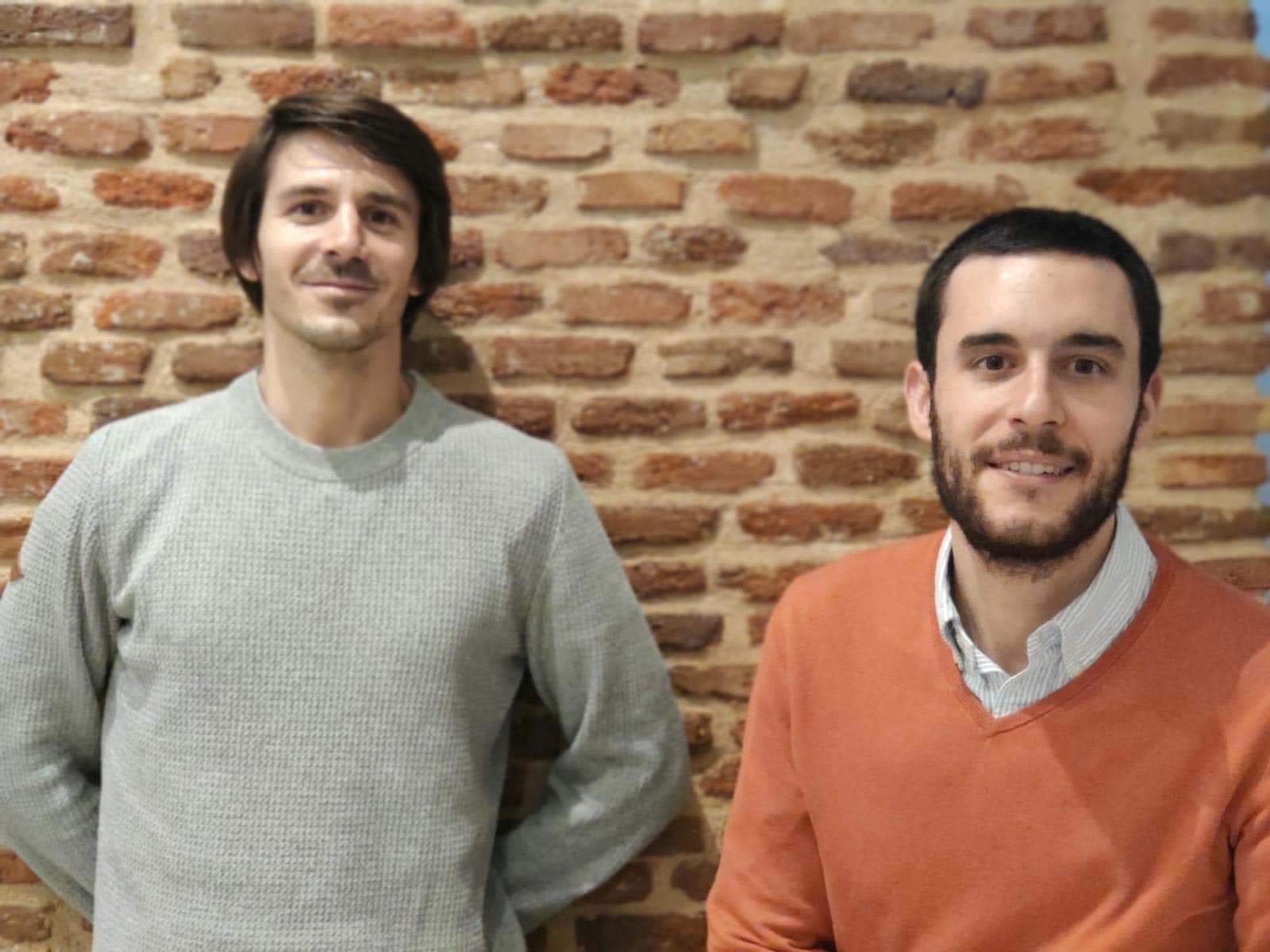
Image: from left to right, Albert Nasarre and Álvaro Cambra, founding partners of Cyrclo.
_
We still remember when this project came to Baud. Back then, it was a great idea that was just beginning to take its first steps towards becoming a reality. Today, Cyrclo is a restaurant whose healthy and Mediterranean gastronomic proposal is not only conquering palates, but also, thanks to its efforts, is making a place in the minds and hearts of many consumers.
We interviewed Álvaro Cambra and Albert Nasarre, two of the founding partners of Cyrclo who tell us how they have managed to reinvent themselves and their restaurant to face with optimism and fighting spirit this health crisis so harmful to the restaurant sector.
Only two months after its opening, Cyrclo has redefined itself to focus on bringing healthy menus to the health workers who are giving so much to all of us these days. From Baud, we are proud and excited to live, in first person, stories of personal and professional growth like this one.
Interviewer: How has the coronavirus affected you personally and professionally?
Álvaro Cambra: We created Cyrclo just 3 months ago and we had only been open for 2 months when the pandemic forced us to close. Accepting it and facing it was, at first, a hard process. Entrepreneurship always involves risks and a context as negative as this one has made it even more complicated. However, Albert and I are ambitious and fighting people and together we have been able to face it in a much more optimistic way.
Albert Nasarre: On a personal level, we are not living in confinement because our day-to-day work continues in the restaurant. In fact, I would say that this situation has activated us and is allowing us to think faster. The context has presented us with a challenge that is even more challenging for us.
«Tenemos implantado un modelo de restauración organizada que nos permite establecer procesos que aseguran una muy buena calidad».
E: How did Cyrclo react to the coronavirus?
AC: Our first reaction, like everyone else's, was a bit chaotic. We were not clear on what we could do, how far we could go, what impact it was going to have on us or what the consequences would be. We had only had home delivery services for a week and we didn't know if we were going to be able to continue with them. After those initial moments, we took the reins and took the necessary steps to move forward. We were aware that we could not keep our staff, so we had to fight and reinvent ourselves to be in charge of all the processes, cooking ourselves and being ourselves, in the first person, the ones who were going to be at the foot of the cannon.
AN: Perhaps the hardest part of those initial moments was the uncertainty we felt about our team. It was a complicated situation for everyone and our intention was to be as transparent as possible with all of them, reassuring them and being there for them.
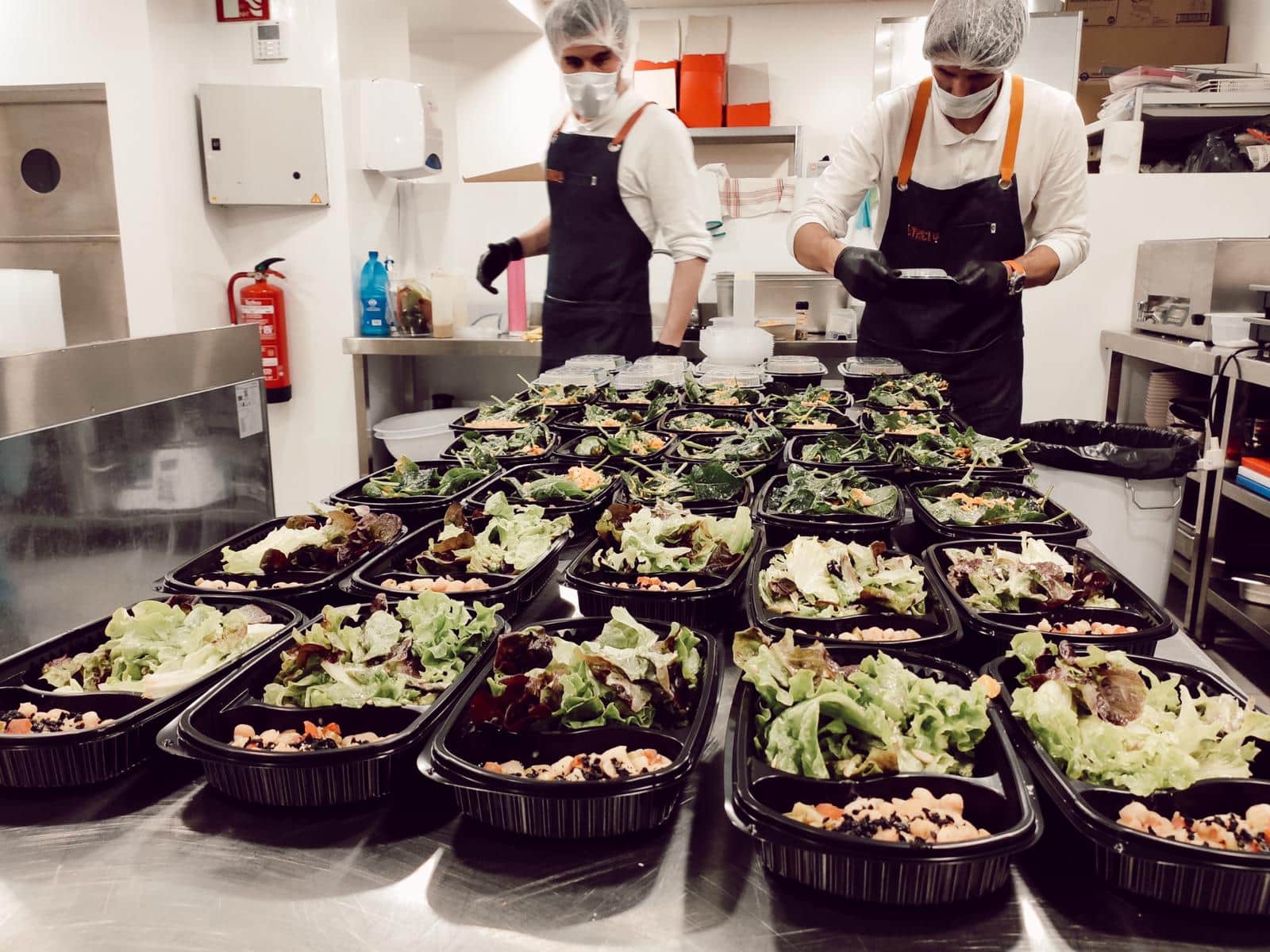
Imagen: cocinas de Cyrclo.
_
E: How has Cyrlo transformed to deal with the pandemic?
AN: Rafa, Cyrclo's third partner, was interested in the Food For Heros initiative. We contacted them and joined, but in this movement, restaurants assume the costs to feed health workers and, in our case, it was not feasible. Therefore, we sat down with María Pascual, a friend of ours, with other catering companies in Barcelona and with the association Ajudant Ajudar to raise a crowdfunding that would allow us to continue helping. Since then, we have not stopped cooking to bring our healthy catering proposal to the sanitary.
«Nuestra supervivencia como compañía a largo plazo pasa por seguir manteniendo vivos nuestros valores».
E: How did you dare to take over the kitchen without having any experience in it?
AC and AN: Since our inception, Cyrclo has implemented an organized catering model that allows us to establish processes that ensure a very good quality in the product and in the final result. Thanks to this, we have been able to enter the kitchens being able to maintain our quality standards and our recipes intact.
E: What feedback have you received since then?
AC: The situation has been very complicated and the general response has been very positive. It is something we were not obliged to do and we are receiving a lot of love and gratitude. At no time did we have any doubts, now it is time to help as much as possible.
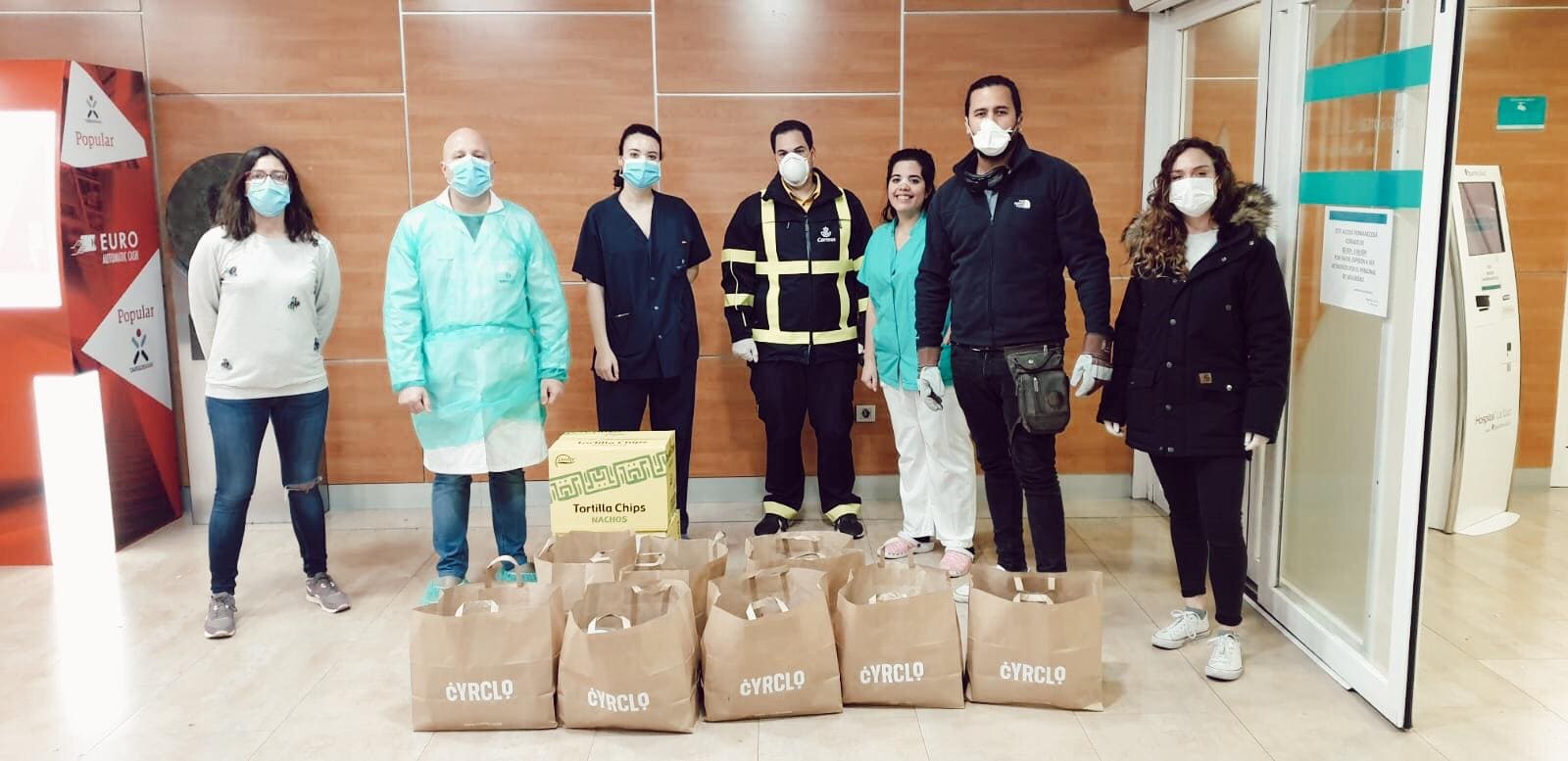
Imagen: sanitarios recibiendo menús de Cyrclo.
_
E: To what extent have Cyrclo's values influenced you to face the transformation in this optimistic and fighting way?
AC and AN: Our brand values are a reflection of who we are and how we think. We are nonconformists, optimists, innovators, and all of that is reflected in how we are living this whole situation. It is our values and our way of being that has driven us to be more reactive and daring. In fact, our long-term survival as a company depends on keeping those values alive and not losing sight of where we want to go.
E: Do you think consumers will take into account the involvement of brands during this pandemic in their subsequent consumption habits?
AC: From my point of view, thanks to this crisis, people today feel more socially responsible. There has been a change in mentality. In these hard times, we are more aware than ever of our responsibility to others, and that is also expected from brands. If a brand actively engages with those who need it most, consumers will feel more receptive and connected to it.
AN: The normality will be responsible brands that commit and act to help society and the planet. This mass production without conscience is becoming increasingly frowned upon on a social level. That's why companies have to be close to people to serve them when they need it. CSR is going to become an essential pillar in all companies.
«Hemos salido reforzados como personas y, en consecuencia, como marca».
E: Which of the initiatives that have arisen in this context have inspired you and caught your attention the most?
AC and AN: In general, we are very inspired by all those initiatives being carried out by small companies that dare and give everything they have to help others, from the Food For Heros initiative promoted by Grosso Napoletano to that of a catering company in Barcelona that gives away menus for healthcare personnel through its E-commerce. Every gesture is important.
E: What do you think life will be like post-coronavirus, how will things change?
AN: Probably, in the short term, our life will change a lot. Our culture is very close and I'm sure our relationships will be affected. Maybe we will become more distant, not with our immediate environment, but we will be more careful with other social practices. I believe that, in the medium term, it will also have an impact on companies because this situation has shown that the Home Office model is possible and that it is also a way of reducing fixed costs. Offices will have to be redefined to allow this flexibility in the location of personnel and, in many cases, spaces will have to be reduced because the presence of the entire workforce will not be necessary.
AC: Sure, at first, there is a lot of fear and we will stop doing things we normally do, but in the long run, we will come back. The Latino society needs to get out, to be with others, to embrace family and friends, so little by little we will resume our full lives.
«Estamos cambiando de mentalidad de forma constante, planteando nuevas ideas y su viabilidad».
E: How would you compare pre-post coronavirus in Cyrclo?
AC and AN: We have come out stronger as people and, consequently, as a brand. We have been able to fight with only 2 months of life and very limited resources. It gives us a lot of hope and fills us with optimism to see how, being only two, we have been able to do so much. It has also opened our eyes to the impact we can have and how far we can go if we are able to fight.
We are confident that our customers value us more and we are reaching and connecting with more people.
«La digitalización de nuestro sector va a ser un requisito imprescindible para continuar en el mercado».
E: What are you doing today to prepare for the post-coronavirus situation?
AC: We are constantly changing our mindset, coming up with new ideas and their feasibility. We want to promote our own E-commerce and pick-up service because we know that the importance of the location is going to be secondary. We are also trying to find new target audiences and we want to introduce our services for companies and employees.
E: Any other comments?
AN: Yes, it is also important to reflect on the restaurant sector and the digital revolution it is undergoing due to the current context. We must be very aware that the traditional restaurant either changes or dies and we have to be very quick to integrate new technologies to be able to remain relevant and survive. Customers, for a while, are not going to come to our restaurants and, therefore, we have to be able to reach them in other ways. The digitization of our industry is going to be a prerequisite to remain in the market.