
By Silvia de Diego, member of the Baud team.
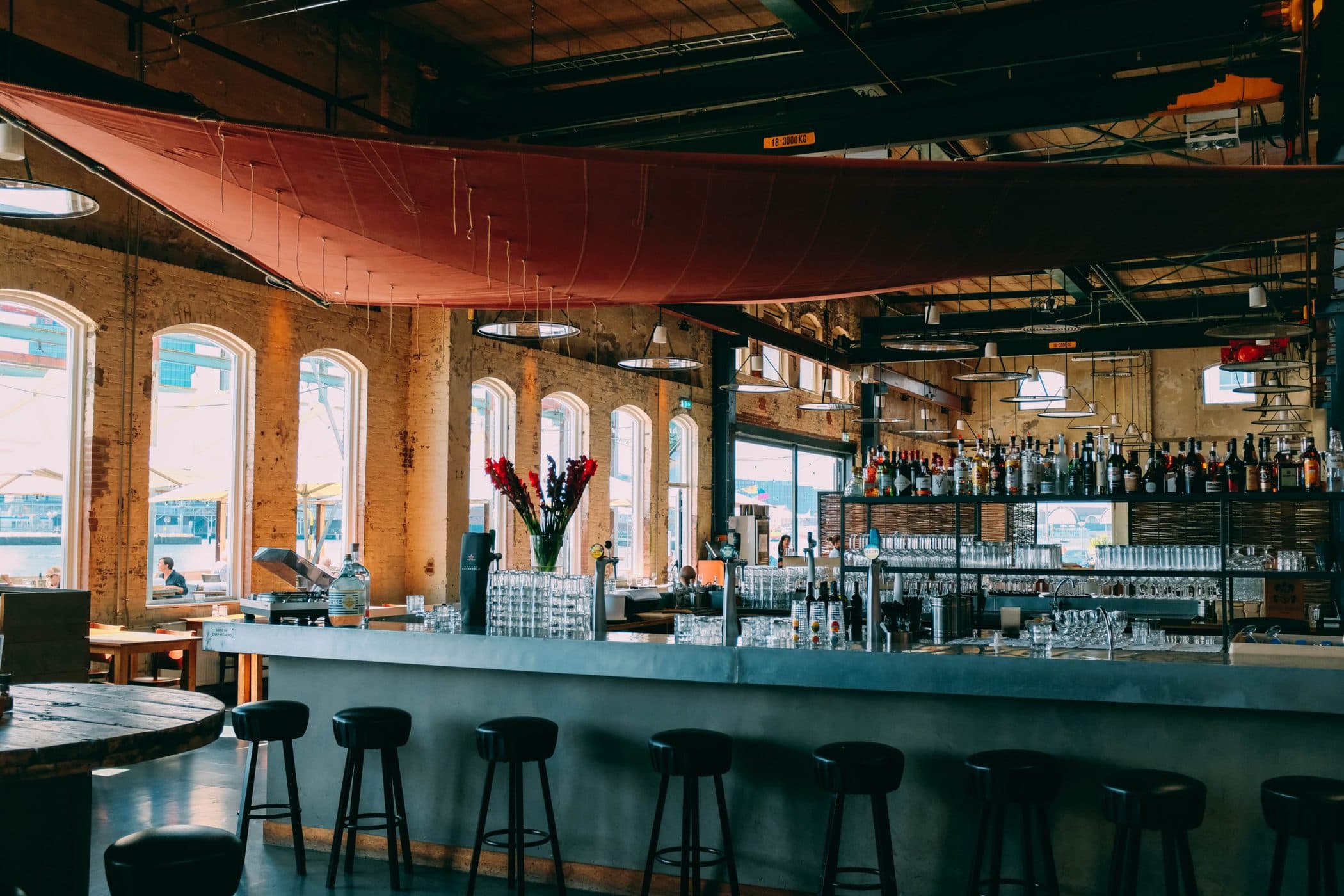
It's Monday morning and a man walks into Manuela's bar. He orders a coffee and a club and spreads his newspaper on the table where he is going to spend the next 3 hours of his day.
The story behind that man can be anyone, rich or poor, married or single, on the first day of his vacation or on the first break of the day. Impossible to guess, because on that side of the bar there could be anyone and an endless number of stories.
Because bars, vermuterías, wine houses, three stars, taverns, cafés, baretos, garitos, garitazos, are part of our collective imagination.
Now the initiative of the platform Juntos por la Hostelería, "Soy Patrimonio 2020", asks to turn them into World Heritage because if we refer to one of the meanings of the RAE for the word culture is: set of ways of life and customs, knowledge and degree of artistic, scientific and industrial development in a given period, social group, etc..
And there's nothing better than a bar for chatting, planning and socializing.
Covid-19 has meant that a sector as traditional as this one has had to deal with the acceptance of new ways of doing things and currents that in other sectors were already a reality a long time ago.
Now that these "institutions" are facing possibly the greatest transformation in their history, it is time to value them and recognize what they bring to us.
At Baud, as a partner to major restaurant brands (and not only because of their size), we have reflected on the immediate future of the sector to uncover the most important drivers of change in these times.
First key
During a meeting organized by the Design Institute of Spain, Ferrán Adriá stressed that the 90% of restaurant businesses are not governed by budgets. A risky practice in contexts of volatility and uncertainty.
Thus, the experts agree that a professional management will be the future of the hospitality industry, starting with a business plan that will make the business survive beyond the 5-year average that 50% restaurants live now.
A planning that comes from the hand of a concept authentic. A concept that conveys a clear value proposition and a well-defined target and offer.
A concept that is capable of guiding the teams, from the chef to the suppliers. As Juli Capella said in the same session at the Design Institute: "it is time for authentic projects, with soul".
This further rationalization is also materialized in the spacesThe interior design has a more orderly division of areas, defined passageways, differentiated access and exit doors, spaces for take away or delivery or entrances prepared to welcome diners and direct them to a specific table.
In short, an integral professionalization that encompasses from the most strategic to the most tactical actions, integrating and providing coherence. So that everything builds in a single direction.
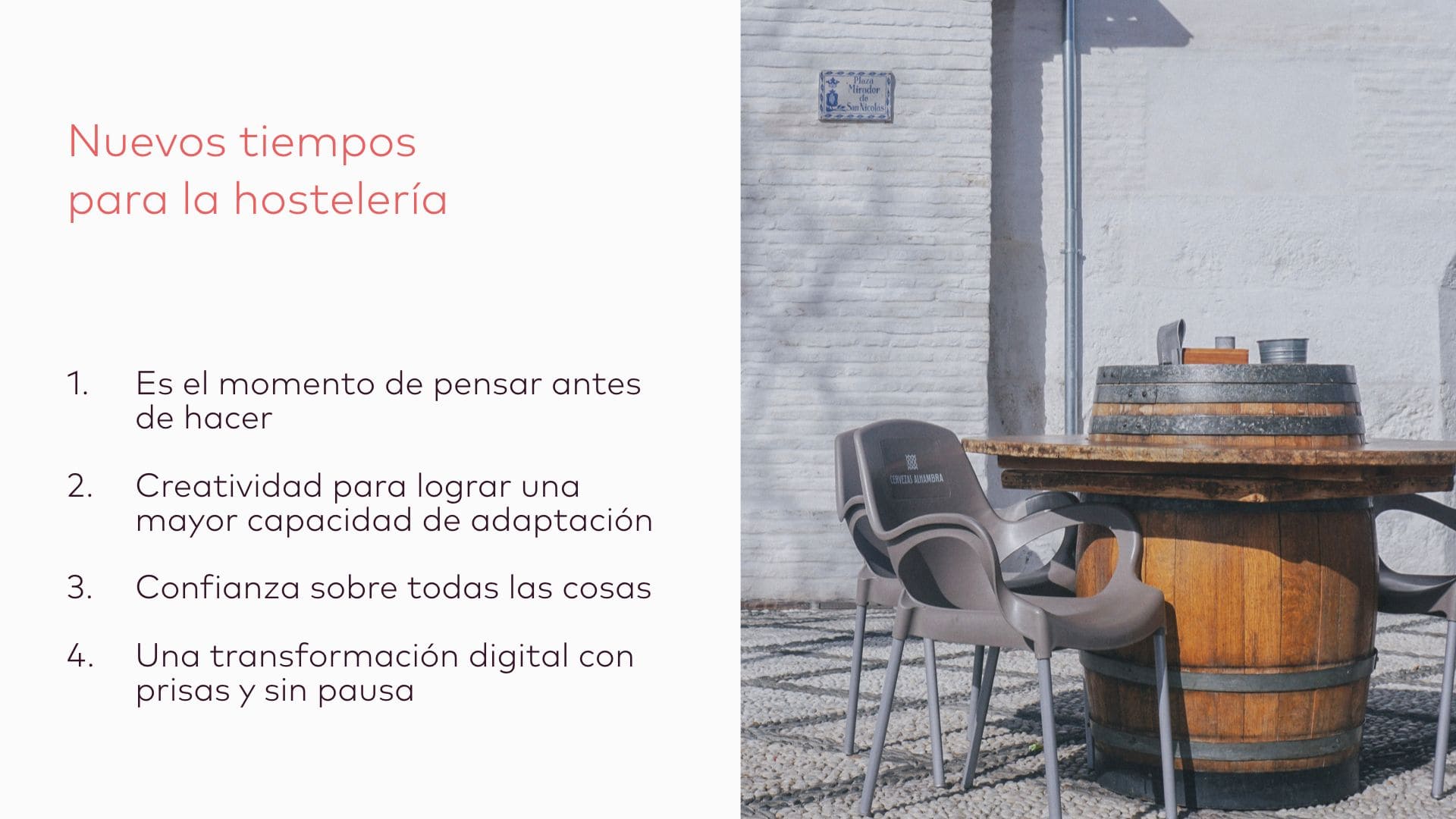
It's time to think before you do.
Second key
Another unknown in the future of the hospitality industry will be the emergence of new business models or the reformulation of previous ones as a response to new forms of consumption.
In this case, the telework seems to be the most decisive factor.
The change in schedules and routines predicts for some a model close to the Anglo-Saxon one, in which lunch becomes a quick snack in front of the computer and dinners are taken outside.
This change in habits will also drive the expansion of innovative formats such as the snack barsself-service establishments of ready-to-eat meals.
Kantar España forecasts, according to its statistical studies, that in the next 5 years this business model will grow by 400%.
In the same way, the search for the outdoors will affect the usual conception of the premises. Thus, terraces, patios, or spaces capable of creating experiences that simulate these sensations, are the new gold.
It is, therefore, the time to test adaptability.
In this context, we need brands that are strategically designed to support the business, flexible and adaptable, capable of providing extra resilience.
Creativity to achieve greater adaptability.
Third key
The pandemic has undoubtedly led us to question hygiene and safety in the hospitality industry.
For example, the Basque pintxos displayed on the counter and within easy reach are a culinary attraction, a tourist attraction and gastronomic heritage that does not know what its future will be.
Because with regard to security The latter used to be about hiding, but now it is an element to show.
This will affect the incorporation of materials The new gadgets are aseptic and in line with stricter regulations and the need to integrate them into the space, along with other new gadgets, in the most organic way possible.
Once again, creativity puts us to the test.
The technology applied to this new context has initially led us to solutions that avoid contact as much as possible: menus through QR codes, screens or payment systems of all kinds to avoid cash.
From now on, we will see that projects are incorporating more and more "secure technologies" from their inception: capacity control systems, automatic taps or doors, etc.
Generate that perception of security in order to ultimately achieve the trust customer's satisfaction will be one of the most valued factors.
A confidence that also augurs the choice among all the offer by criteria of proximity and a greater loyalty to your restaurant or bar of always.
It is the time of safe brands and of brands that are close, that empathize and convey transparency and honesty to connect and achieve the best possible...
Trust above all things.
Fourth key
Finally, and as we advanced, the sudden (for some) digitalization is here to stay.
In many cases, due to the need for the implementation of a service delivery that expands the experience to the digital world forcing more than ever the creation of coherent, consistent and differential experiences at any of the brand's touch points.
Undoubtedly the pandemic may have been the flame that lit the fuse, but sooner or later, as has happened in other sectors, it was necessary to embrace the digital world with solutions such as the incorporation of management systems, POS software, or even the incursion into social networks and web.
Others are leading the way, such as McDonalds, which is advancing in digitalization with street mupis where orders can be placed by voice and QR code reading.
In this sense, the brand provides some essential resources in the digitalization process. Because if you are digital, you have to tell the world, and the world has to believe it.
A digital transformation with haste and without pause.
It remains to be seen whether these changes will bring about a real revolution in the sector.
For the moment, the real revolution, especially for small businesses, has been to learn how responsive and adaptable they are to change.
And they have it, they really have it.
For our part, we will continue to build strong brands that can withstand a virus or all of them.
Brands that continue to build the future of the hospitality industry, so that it remains the hotbed of stories we all want it to be.
_